7 Marrakech Scams to Avoid
Morocco guide
7 Marrakech Scams to Avoid
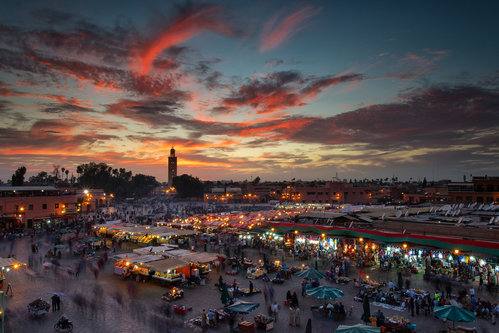
The tricks every first-timer meets in the Red City — reported by real travelers, with the exact words and moves that shut each one down.
I'm Moroccan, and I want to be straight with you: Marrakech has more tourist scams than anywhere else in the country. Not dangerous scams — annoying scams, designed to separate you from $5–50 with a smile. Thousands of travelers experience them every week, and almost all of them are avoidable once you know the script.
Here are the seven you'll actually encounter, in rough order of frequency.
1. The "closed attraction" + the relay
The most-reported Marrakech scam, by far. You're walking toward Bahia Palace or the Ben Youssef Madrasa when a friendly man stops you: "It's closed today — Berber holiday / prayer time / renovations." Then: "But I can show you something better — the tanneries, just up there!"
You follow. He hands you to a "Berber friend." Who hands you to a tannery guide. Who walks you through a carpet shop. Who introduces an oil "chemist." At the exit, every single one demands money. One British couple in 2024 followed this exact relay and got hit for 200 MAD at the tannery exit alone — realizing mid-scam but unable to extract themselves politely.
What to do: the attraction is not closed. Smile, say "la, shukran" (no, thanks), and keep walking. Never stop for more than a second. If you genuinely need directions, ask a shopkeeper inside their shop — they're stationary, accountable, and usually helpful.
2. The henna ambush
In Jemaa el-Fna, women offering henna will grab your hand and start drawing before you agree to anything — then demand an exorbitant price for a design you never asked for. They disproportionately target women and girls who look hesitant.
Beyond the money: travelers warn that the cheap black henna paste can cause chemical burns and rashes. Real henna is reddish-brown and takes hours; jet-black "henna" that develops in minutes is a red flag.
What to do: hands in pockets in the square, or a preemptive "la, shukran" with eye contact before they reach you. If you actually want henna, get it at your riad or a reputable salon — not from a stranger's squeeze bottle.
3. The "I don't want money" chain
A trustworthy-seeming helper insists he wants nothing — he's just being kind, welcome to Morocco! Then he introduces his "friend," who walks you somewhere, who introduces another friend… and the last link in the chain demands cash, sometimes aggressively.
What to do: the moment someone attaches themselves to you uninvited, the answer is the same: "la, shukran," keep walking, don't engage with the follow-up conversation. Kindness from strangers exists in Morocco — but it doesn't chase you down the street.
4. Photo shakedowns
The snake charmers and monkey handlers in the square will drape an animal on your shoulders for a photo — then demand 100+ MAD for the privilege. One traveler put it perfectly: the price is decided after the photo, which means it's whatever they think you'll pay.
What to do: agree the price before the photo (20–30 MAD is fair), or skip it entirely. My honest advice: photograph the square from a rooftop café instead. Better pictures, zero negotiation, mint tea included.
5. The taxi meter that "doesn't work"
Especially at night and at the airport: "meter broken, my friend, fixed price." The fixed price is always inflated. One traveler paid $50 for the airport–riad ride on arrival — and $15 for the identical ride a week later once he knew the real rate.
What to do: insist on the meter — say "compteur" before you close the door. If they refuse, walk to the next taxi; there are hundreds. From the airport, the official rate to the medina is roughly 70–100 MAD ($7–10). At night, expect to negotiate a bit above meter — that's normal — but $50 is a scam.
6. Change tricks and small-money games
Death by a thousand dirhams: foreign coins slipped into your change as if they were dirhams, change returned coin-by-coin hoping you walk away early, a 1.5 MAD bread rung up to pocket 4 MAD of your 10. Individually trivial; collectively the most common scam in the country.
What to do: count your change, every time, without embarrassment. Learn the coins (the bimetallic 10 MAD and 5 MAD are the ones that matter). And keep small bills — paying with a 200 MAD note for a 10 MAD item invites "no change" games.
7. Shop steering for commission
Your "guide" — real, fake, or a café waiter moonlighting — walks you into carpet shops, "Berber pharmacies," and argan oil cooperatives. Every purchase earns them 30–50% commission, which is baked into the price you're quoted. One solo traveler was diverted by a café waiter into a "spice tour" that turned out to be just a shop with a sales pitch.
What to do: never buy on a guided visit. If something catches your eye, note the shop's location, leave, and come back alone later (or don't). For fixed, fair prices with zero haggling, visit the government-run Ensemble Artisanal first — it calibrates your sense of what things should cost.
The one rule that defeats all seven
Travelers who've been through it repeat the same defense: firm "la, shukran" + keep walking. Don't stop. Don't explain. Don't feel rude — the scammers don't feel rude taking your money.
A few more practical shields:
- Download offline maps (Google Maps or Maps.me). Half the scams start with "you look lost."
- Book guides only through your riad, and check for the official guide badge.
- Emergency numbers: police 19, ambulance 15.
A note on the drug setup
You'll be offered hashish — especially around Chefchaouen and the Rif, sometimes in Marrakech. Say no and walk away. This isn't just a sales pitch: travelers report setups where the dealer is followed by fake police demanding a bribe, or outright robbery. Possession is illegal, and "but he offered it to me" is not a defense.
Don't let this list scare you off
Here's the perspective I give friends: these scams are annoying, not dangerous. Violent crime against tourists in Marrakech is rare. The city is genuinely magical — the square at dusk, the call to prayer over the medina, the food — and 99% of your interactions will be warm and honest.
The scammers are a tax on the unprepared. Now you're prepared. Go enjoy the Red City.
I'm Moroccan. These are the scams travelers actually report (2024–2026), not urban legends — every one above comes from real trip reports. Stay sharp, stay kind, and don't let the 1% ruin the 99%.


Comments
Post a Comment